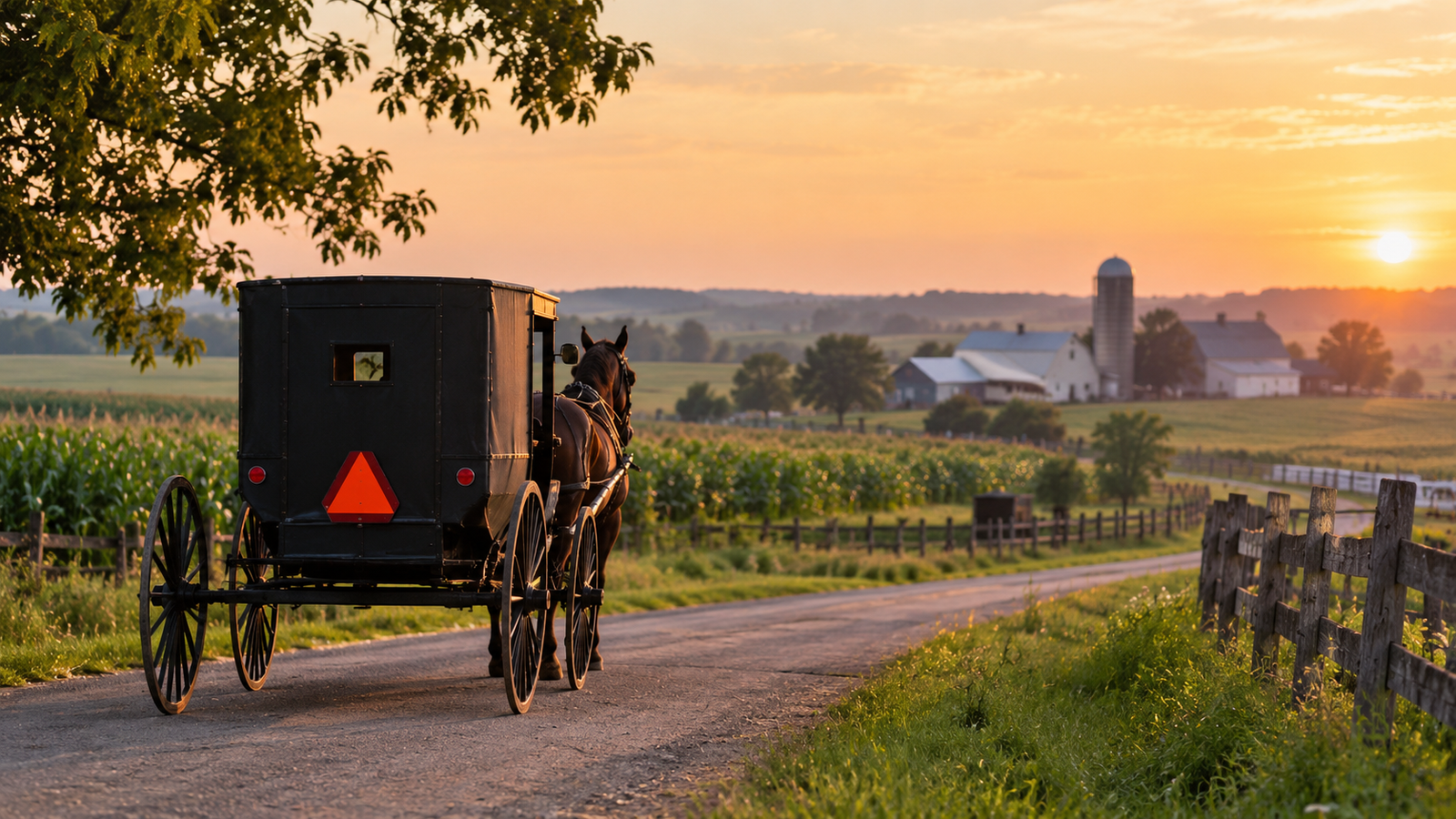
Amish vs Mennonite: What is The Real Difference | Explained
The short answer
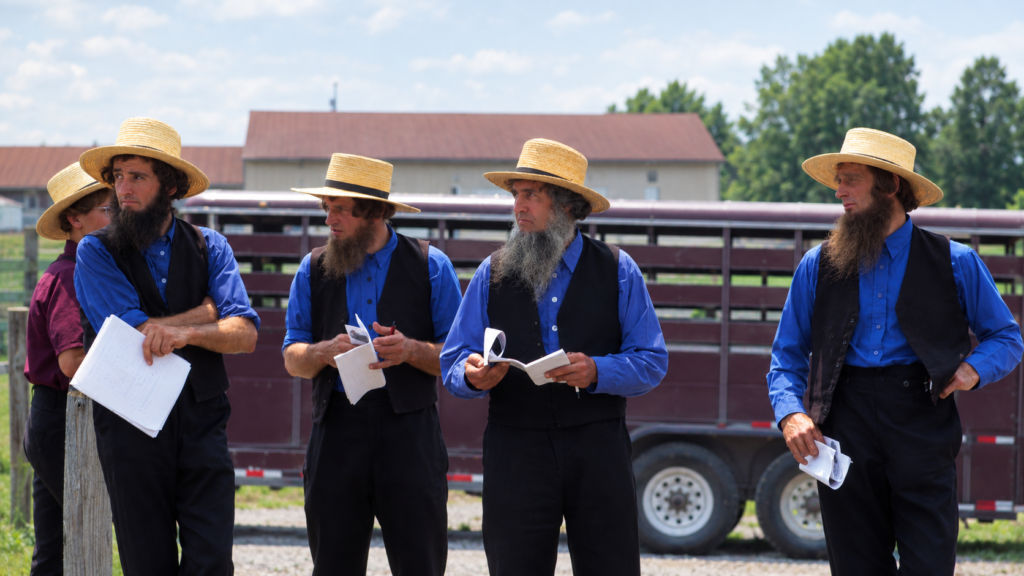
Amish vs Mennonites, both Anabaptist Christians whose story began in Zurich, Switzerland, in 1525. The Amish separated from other Swiss Anabaptists in 1693 under Jakob Ammann. Today the Old Order Amish drive horse-and-buggies, stay off the public power grid and hold church in members’ homes. Most Mennonites drive cars, use electricity and worship in meetinghouses, though Old Order Mennonites still live much like the Amish. The quickest clue for a visitor: Amish men grow beards without mustaches once married, and Amish churches do not allow members to own cars.
On this page
- The short version
- Where both groups came from
- What Amish and Mennonites still share
- Side-by-side comparison
- Differences you can see from the road
- How church life differs
- Language at home and in church
- School and work
- Do Mennonites have Rumspringa?
- A spectrum, not two boxes
- What about Hutterites?
- Where Amish and Mennonites live
- How many Amish and Mennonites are there?
- Common questions
- Keep reading
- Sources
It’s one of the questions people ask most when they visit Lancaster County or Holmes County: “Was that lady in the bonnet Amish or Mennonite?” Often the honest answer is “it depends which Mennonites you mean.” The two churches are close relatives, a little like cousins who grew up on neighboring farms. They share family names, old books and many beliefs, but they made different choices about how to live in the modern world.
This guide walks through the history, the beliefs both groups hold, the everyday differences you can see from the road, and the many groups in between.
The short version
- Same family tree. Amish, Mennonites and Hutterites are the three main branches of the Anabaptist movement.
- The Amish are a branch that split off. In 1693, Jakob Ammann and his followers broke from the Swiss Brethren (early Mennonites) over church discipline.
- Cars are the clearest dividing line. Every Amish group forbids owning a car. Almost all Mennonites allow it, apart from a few Old Order groups.
- Mennonites are far more varied. Some look Amish; most look like any other American churchgoer.
- Mennonites are far more numerous worldwide. About 2.1 million Anabaptists belong to churches in the Mennonite World Conference family, most of them in Africa, Asia and Latin America. The Amish number about 421,200, almost all in the United States and Canada.
Where both groups came from
1525: The first adult baptisms in Zurich
On January 21, 1525, a small group of young reformers met in a house in Zurich, Switzerland, and baptized one another as adults. They believed baptism should follow a personal decision of faith, not happen to infants. Their opponents called them Anabaptists, meaning “rebaptizers.” These first Swiss Brethren included Conrad Grebel, Felix Manz and George Blaurock.
In 1527, Swiss Brethren leaders agreed on seven articles of faith, now called the Schleitheim Confession. It taught adult baptism, separation from the world and refusal to use the sword. Both Amish and Mennonites still trace their convictions to these early teachings.
Persecution and the Martyrs Mirror
Catholic and Protestant authorities alike treated Anabaptists as dangerous. Thousands were imprisoned, drowned or burned. Felix Manz was drowned in Zurich’s Limmat River in 1527.
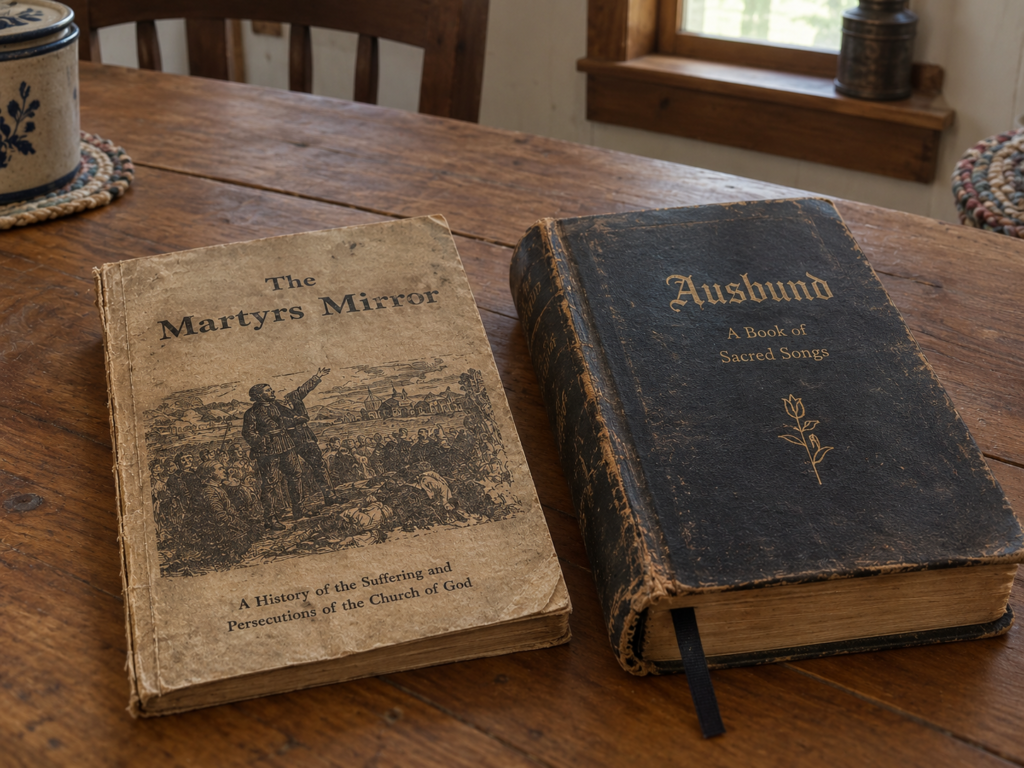
Their stories were collected in a thick book printed in 1660, Het Bloedig Tooneel, of Martelaers Spiegel, known in English as the Martyrs Mirror. Its best-known story tells of Dirk Willems, who escaped prison across a frozen pond in 1569, then turned back to pull his pursuer out of the ice, and was recaptured and burned. Many Amish and conservative Mennonite homes still keep a copy of the Martyrs Mirror, often handed down through the family.
From Saul
[SAUL: Is there a Martyrs Mirror in your home or your parents’ home? Do you remember when you first heard the Dirk Willems story, perhaps from a minister or a schoolteacher?]
Menno Simons and the name “Mennonite”
Menno Simons (1496–1561) was a Catholic priest in Friesland, in today’s Netherlands. He left the Catholic Church in 1536 and became a leading Anabaptist teacher. His writings were so influential that Dutch and North German Anabaptists came to be called “Menists” or Mennonites. Over time the name also stuck to the Swiss Brethren.
In 1632, Dutch Mennonites wrote the Dordrecht Confession of Faith. The Amish and many Old Order Mennonites still use it today, which is one more sign of how close the two families remain.
1693: Jakob Ammann and the Amish division
By the late 1600s, many Swiss Brethren had moved to Alsace (in today’s France) and the Palatinate (in Germany) to escape persecution in Bern. Jakob Ammann, an elder living near Sainte-Marie-aux-Mines in Alsace, felt the church had grown too comfortable. He called for:
- Shunning (Meidung) of excommunicated members in daily life, including at the table, not only at communion.
- Communion twice a year instead of once.
- Foot washing as part of the communion service.
- Plain, uniform dress, including untrimmed beards for men.
- Firmer teaching that sympathetic outsiders (the Treuherzigen, or “true-hearted”) could not be saved unless they joined the church.
Hans Reist, an elder in Switzerland, disagreed, especially about strict shunning. The dispute ended in a painful division in 1693. Ammann’s followers became known as the Amish. The others continued as Swiss Brethren and Mennonites. Ammann’s side later apologized for how harshly the split was handled, but the two groups never reunited.
Coming to America
William Penn’s promise of religious freedom drew both groups to Pennsylvania.
- 1683: Mennonite and Quaker families from Krefeld, Germany, founded Germantown, near Philadelphia.
- 1710: Swiss Mennonite families settled along Pequea Creek in what became Lancaster County.
- 1737: The ship Charming Nancy brought one of the first sizable groups of Amish families to Philadelphia. Early Amish settlements grew in Berks, Chester and Lancaster counties.
In the 1800s, both groups moved west into Ohio, Indiana, Illinois and Iowa. Many Amish congregations of that century became more progressive and eventually merged with Mennonite conferences. The congregations that held to the old ways came to be called the Old Order Amish, the group most people mean by “Amish” today.
A separate stream of Mennonites, often called Russian Mennonites, moved from the Netherlands and Prussia to the Russian Empire (today’s Ukraine) in the late 1700s, then to Kansas, Manitoba and later Mexico, Paraguay and Bolivia. They speak Plautdietsch (Low German), a very different dialect from the Pennsylvania Dutch spoken by the Amish.
What Amish and Mennonites still share
Ask an Amish bishop and a Mennonite pastor what they believe, and their answers on the basics would sound much alike.
- Adult (believer’s) baptism. A person joins the church by choice. Amish youth are usually baptized between about 18 and 22; Mennonite youth often in their teens.
- Nonresistance. Both teach following Jesus’ command to love enemies. Members generally refuse military combat, and many served as conscientious objectors in Civilian Public Service camps during World War II.
- Discipleship in daily life. Faith is shown by how you live, work and treat neighbors, not by words alone.
- The church as a community. Members are accountable to one another and help one another.
- Mutual aid. Both rely on church members to help with hospital bills, fire losses and barn raisings. Amish and Mennonites alike volunteer with Mennonite Disaster Service to rebuild homes after floods and storms.
- Shared books and songs. The Martyrs Mirror and the Dordrecht Confession are honored in both traditions.
- Shared surnames. Yoder, Miller, Stoltzfus, Hershberger, Beiler, Kauffman, Zook, Lapp and King appear in both churches, a reminder of a common past.
Side-by-side comparison
This chart compares the Old Order Amish, the largest Amish group, with mainstream Mennonites in the United States, and adds Old Order Mennonites for reference.
| Practice | Old Order Amish | Old Order Mennonites | Most Mennonites |
|---|---|---|---|
| Transportation | Horse and buggy; hire drivers for long trips | Horse and buggy in some groups; plain black cars in others | Own and drive any car |
| Electricity at home | Not connected to the public grid | Varies; car-driving groups use the grid | Connected to the grid |
| Telephones | Not in the house; phone shanty or business phone | Often allowed, but no internet | Smartphones and internet |
| Men’s grooming | Beard without mustache after marriage | Usually clean-shaven | Any style |
| Women’s dress | Plain cape dress, apron, white or black Kapp | Plain dress, small covering, often print fabric | Everyday modern clothing |
| Worship place | Members’ homes, shops or barns | Plain meetinghouses | Church buildings |
| How often | Every other Sunday, about three hours | Usually every Sunday | Every Sunday |
| Church language | High German readings, Pennsylvania Dutch sermons | Pennsylvania Dutch or German, increasingly English | English or local language |
| Singing | Slow unison hymns from the Ausbund | Unaccompanied singing | Four-part harmony, often with instruments |
| Schooling | Amish one-room schools through eighth grade | Parochial schools through eighth grade | Public and church schools; many attend college |
| Church organization | Independent districts of about 20–40 families | Conferences of congregations | Conferences and denominations |
| Missions | No organized missions | Little outreach | Missions and relief worldwide |
Customs vary. Every Amish church district keeps its own Ordnung, or unwritten church rules, so two districts a few miles apart may differ on details such as bicycles, buggy lights or phones. Mennonite churches range even more widely, from horse-and-buggy groups to fully modern congregations.
Differences you can see from the road
Locals in Amish Country learn to tell Plain neighbors apart at a glance. These are the clues they use.
Vehicles and buggies
Cars are the clearest line. No Amish church permits members to own a car, although members may hire a non-Amish driver, often called an “Amish taxi,” for trips to the doctor, a wedding in another state or work far from home.
Buggies differ by community, too:
- In Lancaster County, Amish families drive gray-topped buggies.
- In Holmes County, Ohio, and most of the Midwest, Amish buggies are black.
- In Pennsylvania’s Big Valley (Mifflin County), different Amish groups drive white-topped, yellow-topped and black-topped buggies.
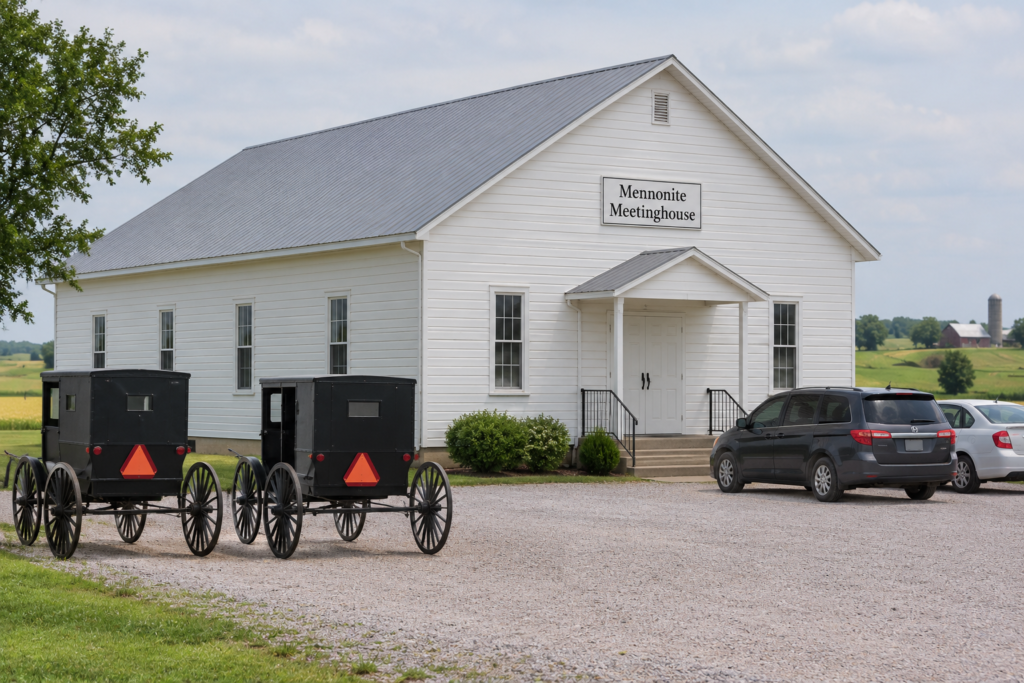
- Old Order Mennonites in Lancaster County, often called “Team” Mennonites or the Groffdale Conference, drive black buggies and use steel-wheeled tractors in the field.
- Another branch, the Weaverland Conference, is nicknamed “black-bumper” Mennonites because members once painted the chrome on their plain black cars.
So if you see a black buggy in Lancaster County, you may be looking at an Old Order Mennonite family, not an Amish one.
Clothing and head coverings
Amish clothing follows the Ordnung closely:
- Women wear solid-colored dresses, often with a cape and apron, fastened with straight pins. A white organdy Kapp (prayer covering) is worn for most occasions, while a black Kapp may be worn by unmarried girls to church in some communities. In Lancaster County, the Kapp is heart-shaped; in Ohio and Indiana, it is more rounded.
- Men wear broadfall trousers with suspenders, solid shirts and a black or straw broad-brimmed hat. Married men grow a beard but shave the upper lip.
Old Order and conservative Mennonite women also dress plainly and wear head coverings, but the coverings are often smaller, and some groups allow small print fabrics. Men are usually clean-shaven.
Mainstream Mennonites dress like their neighbors, though some older women still wear a small covering to church.
For more on what each piece of clothing means, see Amish Clothing Explained.
Homes and farms
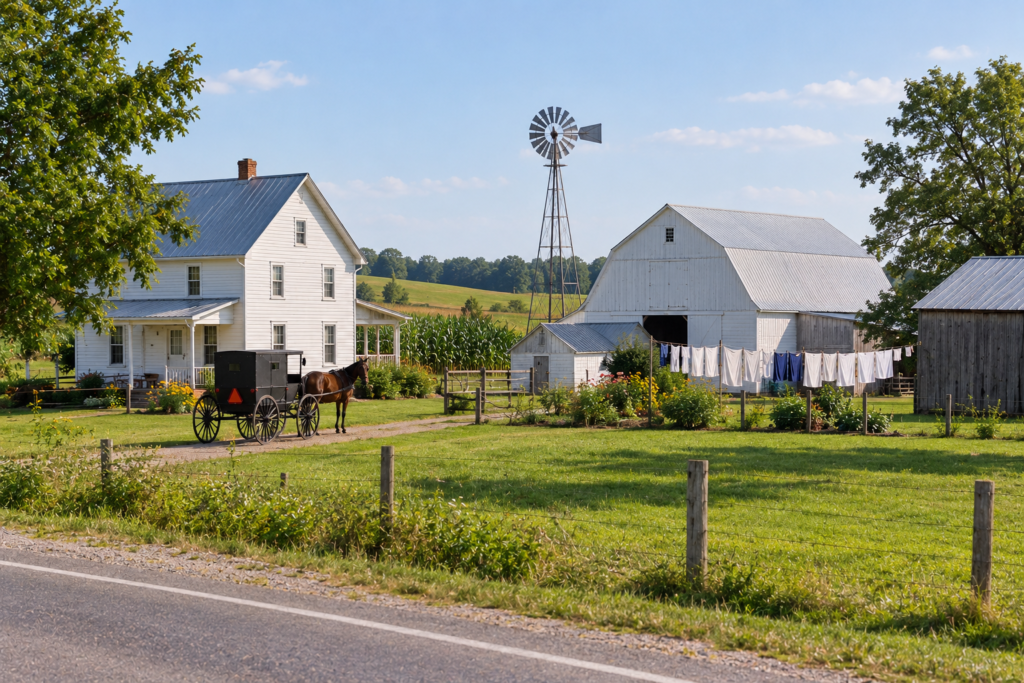
From the road, an Amish farm shows clues: no power lines running to the house, a windmill or diesel engine shed, green window blinds in Lancaster County, laundry drying on a pulley line on Monday mornings, and a phone shanty at the end of the lane. Old Order Mennonite farms may look similar, but many have power lines. A mainstream Mennonite home usually looks like any other country home. To learn how Amish homes run without the power grid, read Do the Amish Use Electricity?.
How church life differs
Amish worship: church in the home
The Amish call their church district the Gmay. A district usually includes about 20 to 40 families who live close enough to travel by buggy. Families take turns hosting the service, which rotates from home to home every other Sunday.
On a church Sunday:
- A bench wagon delivers wooden benches to the host family’s home, shop or barn the day before.
- Men and women sit separately, and the service lasts about three hours.
- The congregation sings slow, unison hymns from the Ausbund, a hymnal first printed in 1564 and often called the oldest Protestant hymnal still in continuous use. A song leader, the Vorsinger, starts each line. The Loblied (“Praise Song”) is always the second hymn, and it can take about 20 minutes to sing.
- Ministers preach in Pennsylvania Dutch without notes, and readings come from the German Luther Bible.
- Afterward, the host family serves a simple fellowship meal. In Lancaster County this often means bread with church spread, a sweet mix of peanut butter and marshmallow creme, plus pickles, red beets and coffee.
Ministers are chosen by lot from men nominated by the congregation. They serve without pay or formal training, for life.
On the “off Sunday,” Amish families often rest, read the Bible at home or visit relatives, sometimes attending a neighboring district’s service.
From Saul
[SAUL: Describe a church Sunday in your district: when the day begins, how the benches arrive, what the meal is, and what the young people do in the evening for the Sunday singing.]
Mennonite worship: the meetinghouse
Most Mennonites gather every Sunday in a meetinghouse or church building. Traditional meetinghouses are plain, with no steeple or stained glass. Many Mennonite churches are known for strong four-part a cappella singing, while others use pianos, guitars and worship bands. Pastors in most conferences are trained and paid, though some conservative groups still choose ministers by lot.
Discipline and shunning
Both traditions practice church discipline, but in very different ways. Among the Amish, a baptized member who breaks a serious rule and won’t repent may be excommunicated and placed under the Bann (ban). Members then practice Meidung, or social avoidance: they won’t eat at the same table or do business with the person, though they may still talk and help in need. The goal is to restore the person to the church, and a member who repents is welcomed back.
Most Mennonite churches do not practice social shunning. A few conservative groups practice a milder form.
Outreach and service
The Amish generally do not seek converts or send missionaries. They see their way of life as a witness in itself. Mennonites are far more active in service and outreach. Mennonite Central Committee (MCC), founded in 1920, runs relief and development work in dozens of countries. Many Mennonite communities hold yearly relief sales, where quilts and food are sold to fund MCC’s work, and Amish quilters often donate to these sales too.
Language at home and in church
Most Amish speak Pennsylvania Dutch (Deitsch) at home, a dialect that grew from the German of the Palatinate. Children learn English when they begin school. Church readings and hymns use High German. The Amish call anyone who isn’t Amish an Englischer (or “English”).
Old Order Mennonites in Pennsylvania and Ontario also speak Pennsylvania Dutch, though many congregations now worship partly in English. Russian Mennonite communities in Mexico, Belize, Paraguay and Bolivia speak Plautdietsch. Most Mennonites in the United States speak English only.
Here are a few words you may hear when Amish and Mennonite neighbors talk:
| Word | Meaning |
|---|---|
| Englischer | Anyone who isn’t Amish |
| Gmay | A church district or congregation |
| Ordnung | A district’s unwritten rules for living |
| Rumspringa | “Running around,” the teen years before baptism |
| Kapp | A woman’s prayer covering |
| Dawdi Haus | A small house for grandparents built beside the main house |
| Gelassenheit | Yieldedness: humble submission to God and the church |
School and work
Amish children usually attend one-room or two-room Amish schools through the eighth grade, taught by a young Amish teacher. The U.S. Supreme Court upheld this practice in Wisconsin v. Yoder (1972). After eighth grade, young people learn by working alongside their parents in the home, on the farm or in a family business.
Old Order Mennonites also run their own parochial schools through eighth grade. Most other Mennonite children attend public or Christian schools, and Mennonites run colleges such as Goshen College in Indiana, Eastern Mennonite University in Virginia and Bethel College in Kansas.
For work, many Amish families still farm, but a growing number run small shops: furniture and cabinet making, harness and buggy shops, produce stands, bakeries, quilt shops and construction crews. Mennonites work in every field, including medicine, teaching, law and business, while conservative groups often keep to farming and trades.
Do Mennonites have Rumspringa?
No, not as the Amish practice it. Rumspringa, meaning “running around,” is the Amish season of youth that usually starts at about 16. Young people join a youth group, attend Sunday evening singings and begin courting before deciding whether to be baptized. Mennonite youth are usually more connected to the wider world from childhood, so there is no comparable stage. Read more in Rumspringa: What It Is and What It Isn’t.
A spectrum, not two boxes
The clearest way to picture these groups is as a line running from most traditional to most modern.
- Swartzentruber Amish are among the most traditional. Many decline the orange slow-moving-vehicle triangle on their buggies and keep homes very plain.
- Old Order Amish are the largest group. They drive buggies and avoid the power grid at home, but many use gas refrigerators, solar panels for batteries and some technology at work.
- New Order Amish still drive buggies but stress personal Bible study, and many forbid tobacco and alcohol.
- Old Order Mennonites include horse-and-buggy groups such as the Groffdale Conference (“Team”) Mennonites and car-driving groups such as the Weaverland Conference.
- Beachy Amish Mennonites separated from the Old Order Amish in Somerset County, Pennsylvania, in 1927 under Bishop Moses Beachy. They drive cars and use electricity while keeping plain dress, and researchers count them among Mennonites, not Amish.
- Conservative Mennonites dress plainly and use modern technology, though many avoid television.
- Mainstream Mennonites, such as Mennonite Church USA congregations, look and live much like other American Protestants.
So the woman in a bonnet at the market could be Old Order Amish, Old Order Mennonite, Beachy Amish Mennonite or Conservative Mennonite. The shape of her covering, the fabric of her dress and the vehicle she arrived in usually tell locals which. To learn more about each Amish group, see our Types of Amish hub.
What about Hutterites?
Hutterites are the third branch of the Anabaptist family. They are named for Jakob Hutter, an early leader who was burned at the stake in 1536. Hutterites live in colonies where all property is owned in common, mostly in the northern Great Plains of the United States and Canada’s prairie provinces. They use modern farm machinery and vehicles but keep distinctive dress and speak a German dialect called Hutterisch.
Where Amish and Mennonites live
| State or region | Notable communities |
|---|---|
| Pennsylvania | Lancaster County, home to large Amish and Old Order Mennonite communities; Big Valley; Somerset County |
| Ohio | Holmes, Wayne and Geauga counties, among the largest Amish settlements in the world |
| Indiana | Elkhart and LaGrange counties; Goshen is a historic Mennonite center |
| Kansas | Many Russian Mennonite congregations and Bethel College |
| Ontario, Canada | Waterloo Region, home to many Old Order Mennonites |
If you visit, these centers explain both traditions:
- Amish & Mennonite Heritage Center near Berlin, Ohio, home to Behalt, a 265-foot cyclorama painting of Anabaptist history.
- Mennonite Information Center in Lancaster, Pennsylvania, which includes a replica of the biblical Tabernacle and offers guided tours of the countryside.
- Menno-Hof in Shipshewana, Indiana.
Planning a trip? Our Lancaster County two-day itinerary includes a stop where you can see both communities respectfully.
How many Amish and Mennonites are there?
The Young Center for Anabaptist and Pietist Studies at Elizabethtown College estimates there were about 421,200 Amish in North America in June 2026, living in 33 U.S. states and three Canadian provinces. Because families are large and most young people join the church, the population roughly doubles every 20 years.
The Mennonite World Conference counts about 2.1 million baptized members in its family of churches worldwide. More than half live in Africa, Asia and Latin America, and Ethiopia, the Democratic Republic of Congo and India have some of the largest Mennonite churches.
From Saul
[SAUL: Do you have Mennonite relatives or neighbors? How do Amish and Mennonite families in your area get along, for example at mud sales, funerals, the local hardware store or a barn raising?]
Common questions
Are Mennonites stricter than the Amish?
Usually not. Most Mennonites are less strict about technology and dress. A few Old Order Mennonite groups, such as the horse-and-buggy “Team” Mennonites, are about as traditional as the Old Order Amish.
Can an Amish person marry a Mennonite?
Only if one partner joins the other’s church. Baptized Amish members are expected to marry within the Amish church.
Do Mennonites practice shunning?
Most Mennonite churches do not practice the social shunning found among the Amish, though some conservative groups practice a milder form.
How can I tell an Amish man from a Mennonite man?
Married Amish men wear a beard without a mustache. Most Mennonite men, including Old Order Mennonites, are clean-shaven.
Do Mennonites use electricity?
Most do. Some horse-and-buggy Old Order Mennonite groups limit it, but car-driving Mennonite groups use the public power grid.
Is “Amish Mennonite” a real group?
Yes. The term usually refers to the Beachy Amish Mennonites and similar churches, which have Amish roots but drive cars and use electricity.
Do Amish and Mennonites speak the same language?
The Amish and many Old Order Mennonites speak Pennsylvania Dutch. Most other Mennonites in the United States speak English, and Russian Mennonite communities speak Plautdietsch.
Do Amish and Mennonites worship together?
Not in regular services, but they often work side by side in disaster relief, benefit auctions and community events.
Keep reading
- Do the Amish Use Electricity?
- Rumspringa: What It Is and What It Isn’t
- Can You Join the Amish?
- The Amish Glossary
Join the conversation
Do you live near Amish or Mennonite neighbors? Tell us in the comments how you first learned to tell them apart, or ask Saul a question this guide didn’t answer.
Ask Saul a question · Get the monthly letter · Share your story
Sources
- Young Center for Anabaptist and Pietist Studies, Elizabethtown College, Amish Population Profile, 2026.
- Mennonite World Conference, World membership statistics.
- Global Anabaptist Mennonite Encyclopedia Online (GAMEO), entries on Amish Division, Jakob Ammann and the Schleitheim Confession.
- Donald B. Kraybill, Karen M. Johnson-Weiner and Steven M. Nolt, The Amish (Johns Hopkins University Press, 2013).
- Donald B. Kraybill, Concise Encyclopedia of Amish, Brethren, Hutterites, and Mennonites (Johns Hopkins University Press, 2010).
- Amish & Mennonite Heritage Center, Berlin, Ohio, Behalt.
- Wisconsin v. Yoder, 406 U.S. 205 (1972).